Yes. You can gain muscle and lose fat after 60, and you can do both at the same time. Muscle keeps responding to the right training well into your 70s and 80s. What changes with age is how hard you have to work for it, and how easy it is to fool yourself if you only watch the bathroom scale.
Below is a real example from our Leichhardt clinic: a 60-year-old man scanned twice on our Hologic DEXA scanner, 16 weeks apart. His name and identifying details have been removed. Every number in this article comes straight from his two scans.
The short version: what changed in 16 weeks
Total lean mass up 5.3 kg, from 52.1 kg to 57.5 kg (+10.3%).
Arm and leg muscle up 2.1 kg. His appendicular lean mass index (ALMI) rose from 7.15 to 7.80 kg/m², a 9.1% increase.
Fat mass down 3.2 kg, from 19.3 kg to 16.2 kg (−16.3%).
Body fat down from 26.0% to 21.1%.
Trunk fat down 2.3 kg (−20%), the largest fat loss of any region.
Visceral fat down from 117 to 108 cm².
Total body bone density up from 1.229 to 1.248 g/cm², a change the scanner flags as statistically significant.
And the part most people find surprising: his total body mass went up by 2.2 kg (74.4 kg to 76.6 kg on the scanner). On a bathroom scale, this looks like going backwards. On DEXA, it is close to an ideal result.
Want to see your own numbers? Book a DEXA scan online.
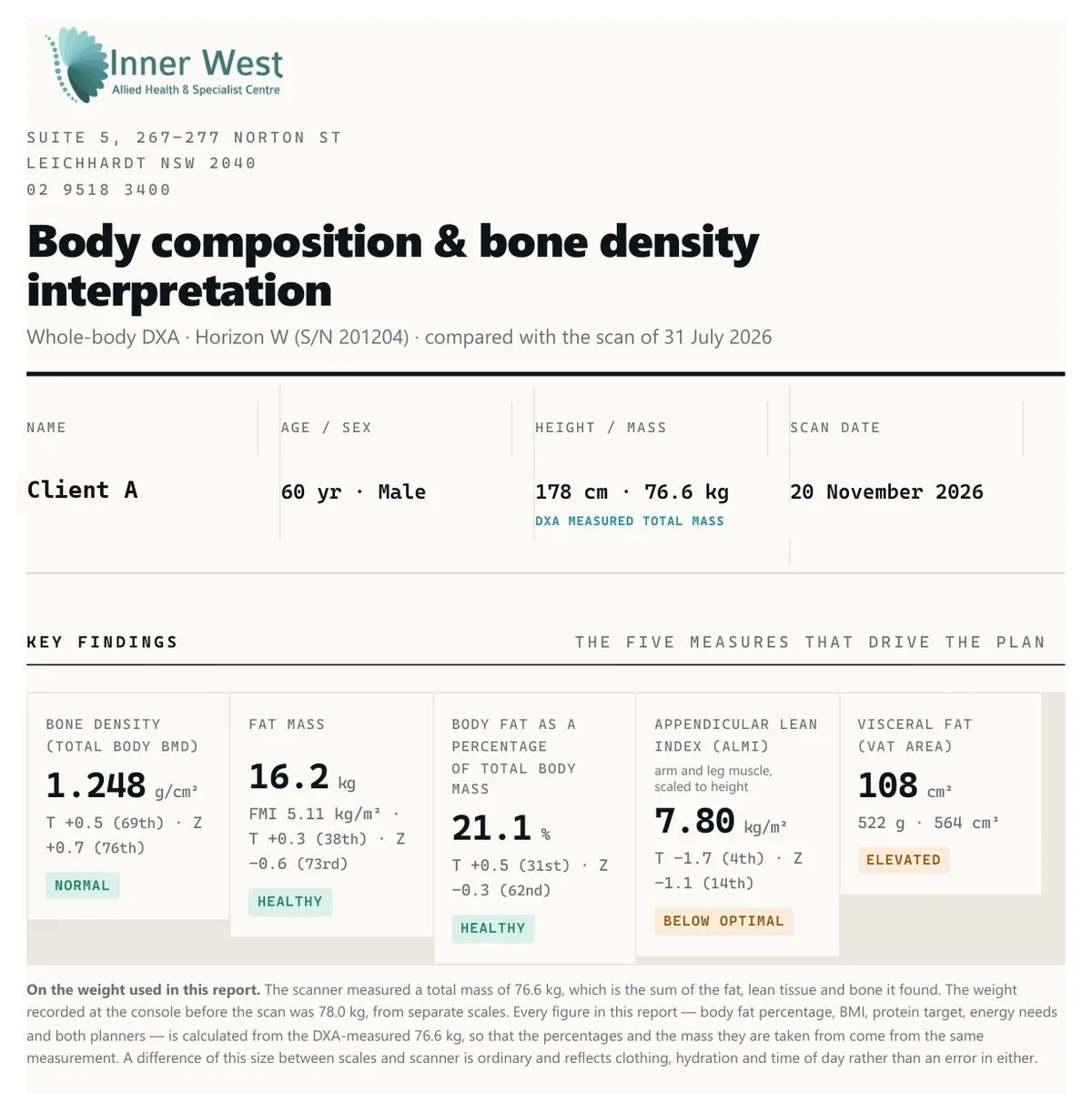
Page 1 of the interpretation report: the five measures that drive the plan. Client details removed.
Why muscle matters more after 60
From middle age onwards most people lose muscle every decade unless they actively train against it. That loss speeds up after 60 and it is the main driver of sarcopenia: low muscle mass combined with low strength or physical performance. Sarcopenia is linked with falls, fractures, loss of independence, poorer blood sugar control and a slower metabolism.
The measure DEXA uses to track this is ALMI, the lean tissue in your arms and legs divided by your height squared. The limbs contain very little apart from muscle and bone, so ALMI is the closest a body composition scan gets to measuring skeletal muscle directly. It is also the measure the international sarcopenia definitions are built on.
At his first scan this client's ALMI T-score was −2.4, well below the healthy range for a man. Sixteen weeks later it was −1.7. Still below optimal, and still the main target of his plan, but moving clearly in the right direction.
The trend: fat down, muscle and bone up
The chart below plots each measure against its own value at the first scan (100%). Lines heading up are ALMI, trunk lean mass and bone density. Lines heading down are body fat percentage, fat mass and visceral fat.
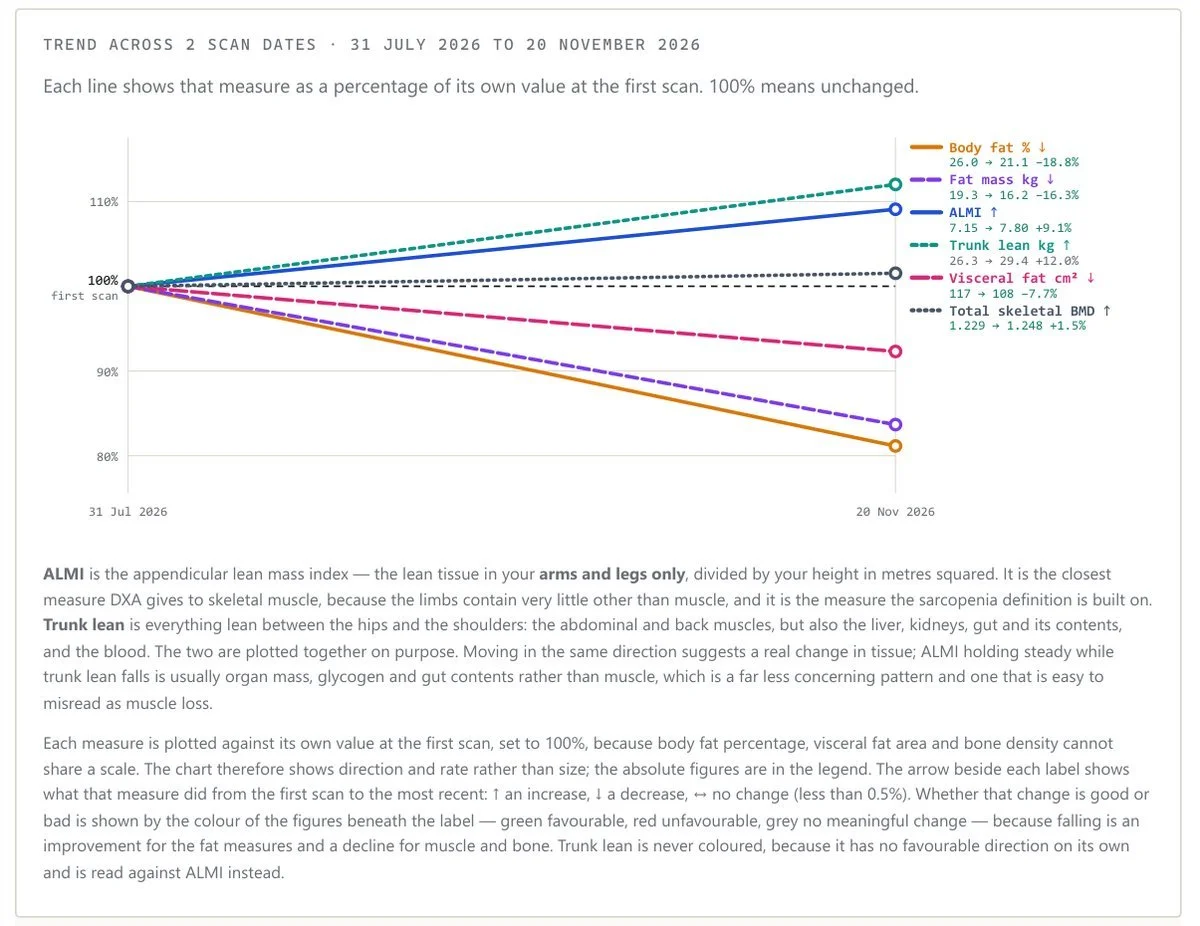
Trend across both scans, 31 July to 20 November 2026. Each measure is shown as a percentage of its first-scan value.
Exactly where the muscle was gained
This is where DEXA earns its place. A bathroom scale gives you one number. A smart scale estimates. DEXA measures fat, lean tissue and bone separately in each arm, each leg and the trunk, so you can see precisely where the changes happened.
Lean mass gained, by region:
Left arm: +464 g (+16.8%)
Right arm: +402 g (+13.1%)
Left leg: +734 g (+9.0%)
Right leg: +467 g (+5.4%)
Trunk: +3.16 kg (+12.0%)
Fat lost, by region:
Trunk: −2.32 kg (−20.0%)
Right leg: −407 g (−16.7%)
Left leg: −321 g (−14.4%)
Right arm: −149 g (−13.0%)
Left arm: essentially unchanged
Every lean change in the arms, legs and trunk was statistically significant (marked * in the tables below). The arms and legs together gained 2.1 kg of lean tissue, and that is the figure we treat as real muscle.
A note on trunk lean mass. Trunk "lean" is everything that is not fat or bone between the hips and shoulders: the abdominal and back muscles, but also the liver, kidneys, gut contents, blood and stored glycogen and water. Part of a 3.2 kg trunk gain will be muscle, and part will be fluid and glycogen that come with more training and more food. That is why we read trunk lean against ALMI rather than on its own. Here both rose together, which is the pattern of a genuine gain in tissue rather than a shift in hydration alone.
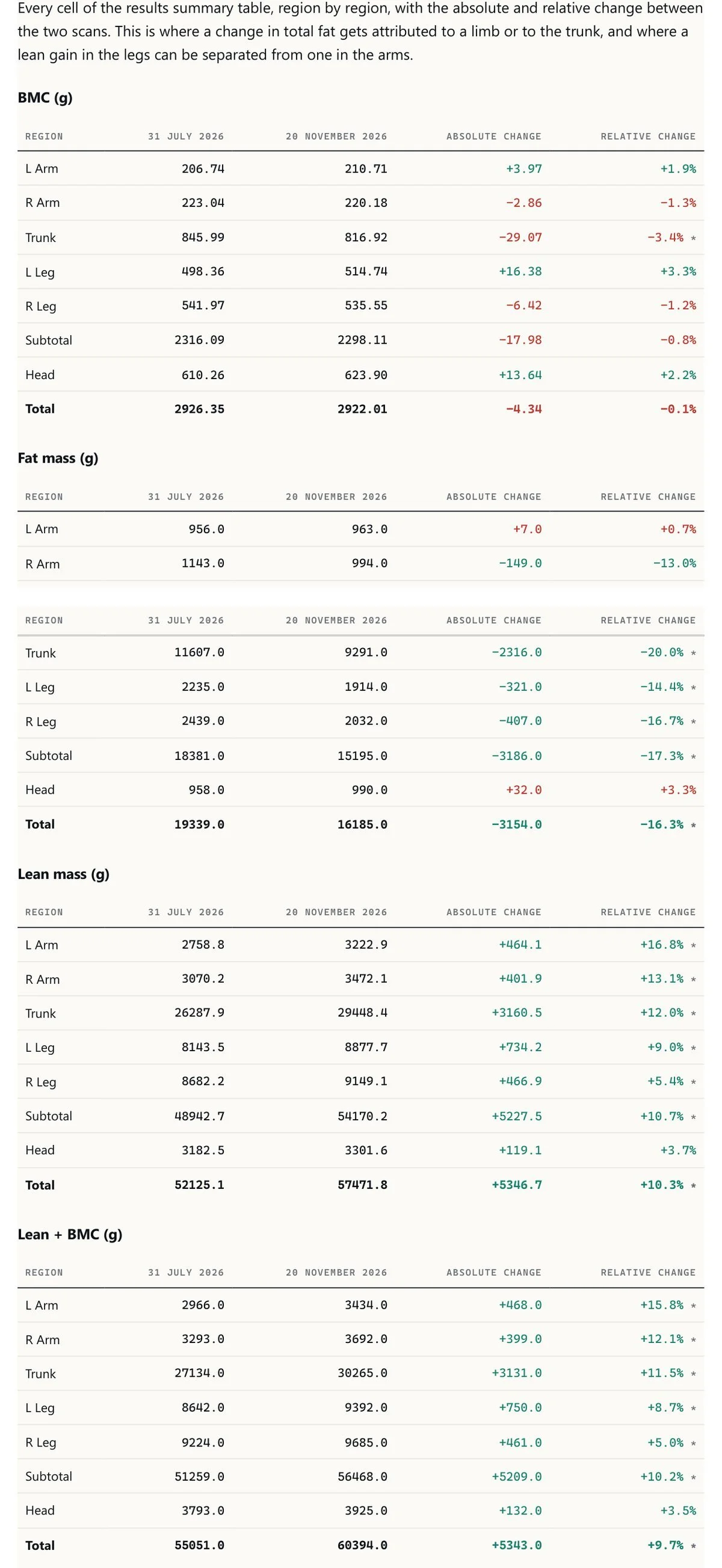
Region-by-region comparison from the interpretation report (pages 13–14). * marks a statistically significant change.
Bone density went up too
Bone is slower to change than muscle or fat, so this is the result we were happiest to see. His total body bone mineral density rose from 1.229 to 1.248 g/cm², and his T-score improved from +0.3 to +0.5.
The Hologic software marks that change as significant at the 95% confidence level. The increase of 0.019 g/cm² is larger than the scanner's least significant change of 0.014 g/cm², the smallest difference that can be trusted as real rather than measurement noise.
Bone responds to load. Progressive strength training and impact work are among the few things shown to maintain or build bone density as we age, which is exactly why they sit alongside muscle in our programs. Whole-body bone readings can also shift a little as soft tissue changes, so for anyone with low bone density we confirm the trend at the hip and spine and over 12 months. If bone health is your main concern, see our bone density testing and bone strengthening program.
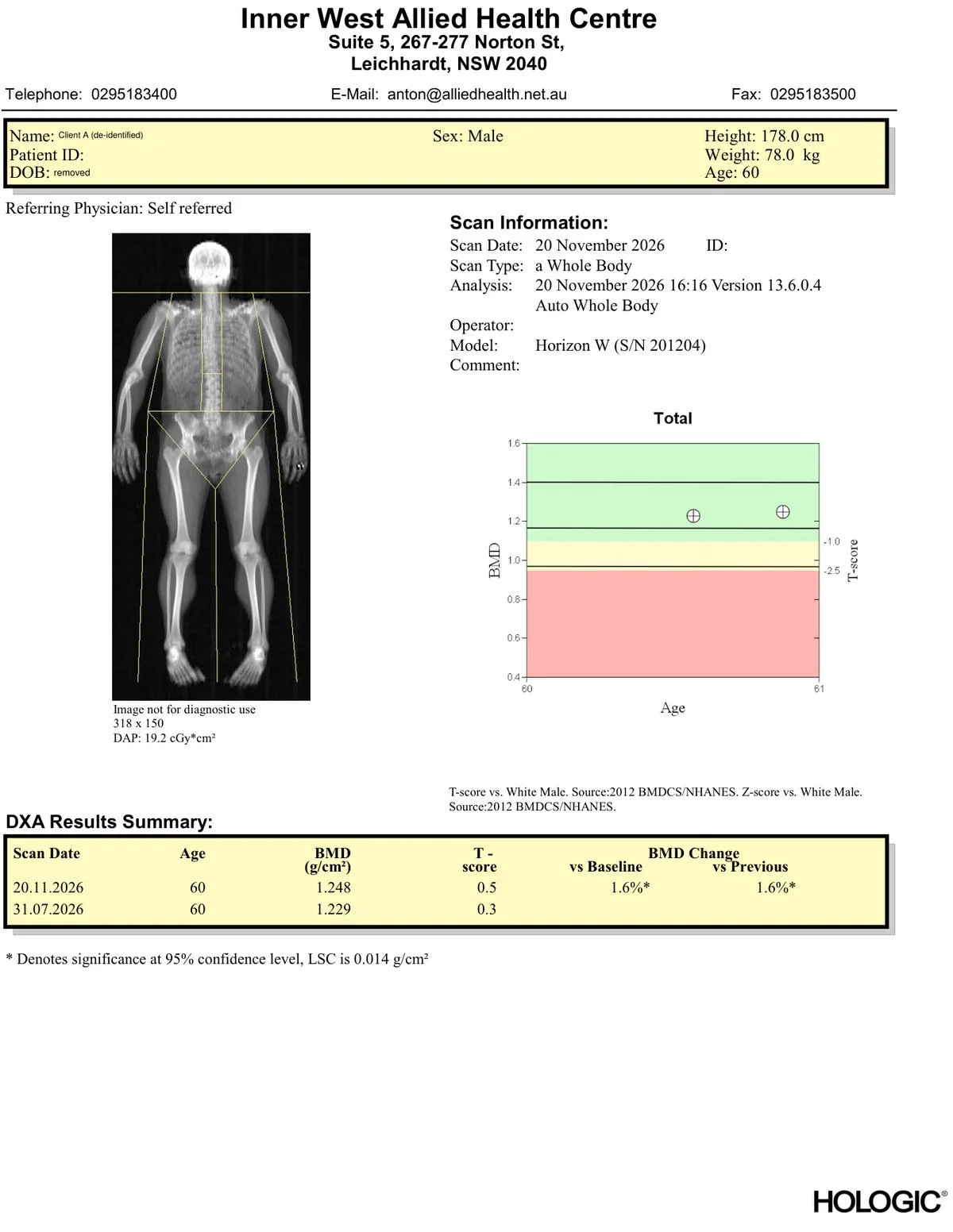
De-identified Hologic report: total body bone density, 31 July vs 20 November 2026. * denotes a significant change (LSC 0.014 g/cm²).
The original Hologic scans
For readers who like to see the raw data, here are the de-identified pages from the Hologic Horizon scanner itself. The colour images show fat (red and yellow), lean tissue (blue and green) and bone. The trend page shows his body fat percentage dropping out of the upper band and his ALMI climbing towards the reference range.
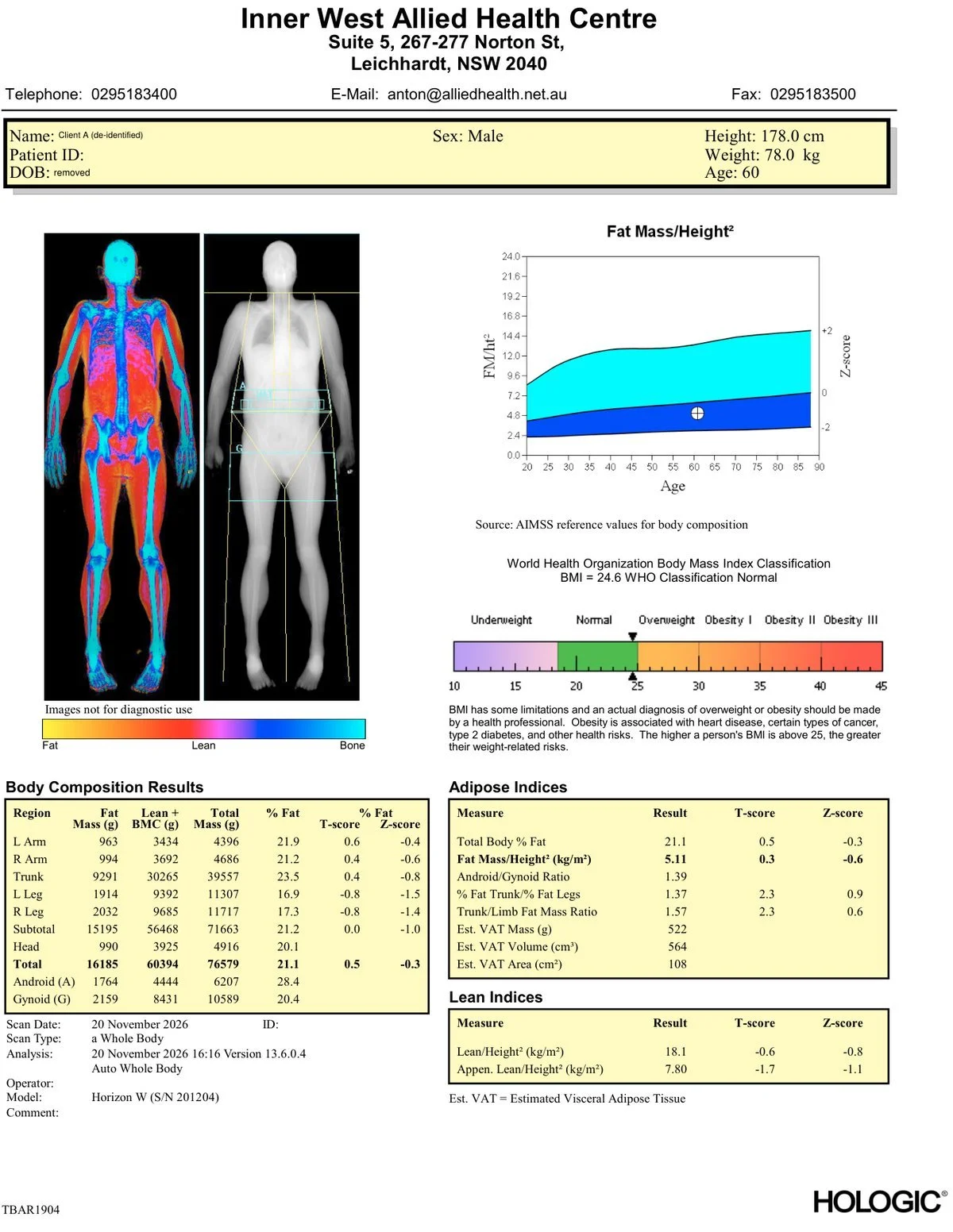
De-identified Hologic body composition results, 20 November 2026: regional fat and lean mass, adipose and lean indices.
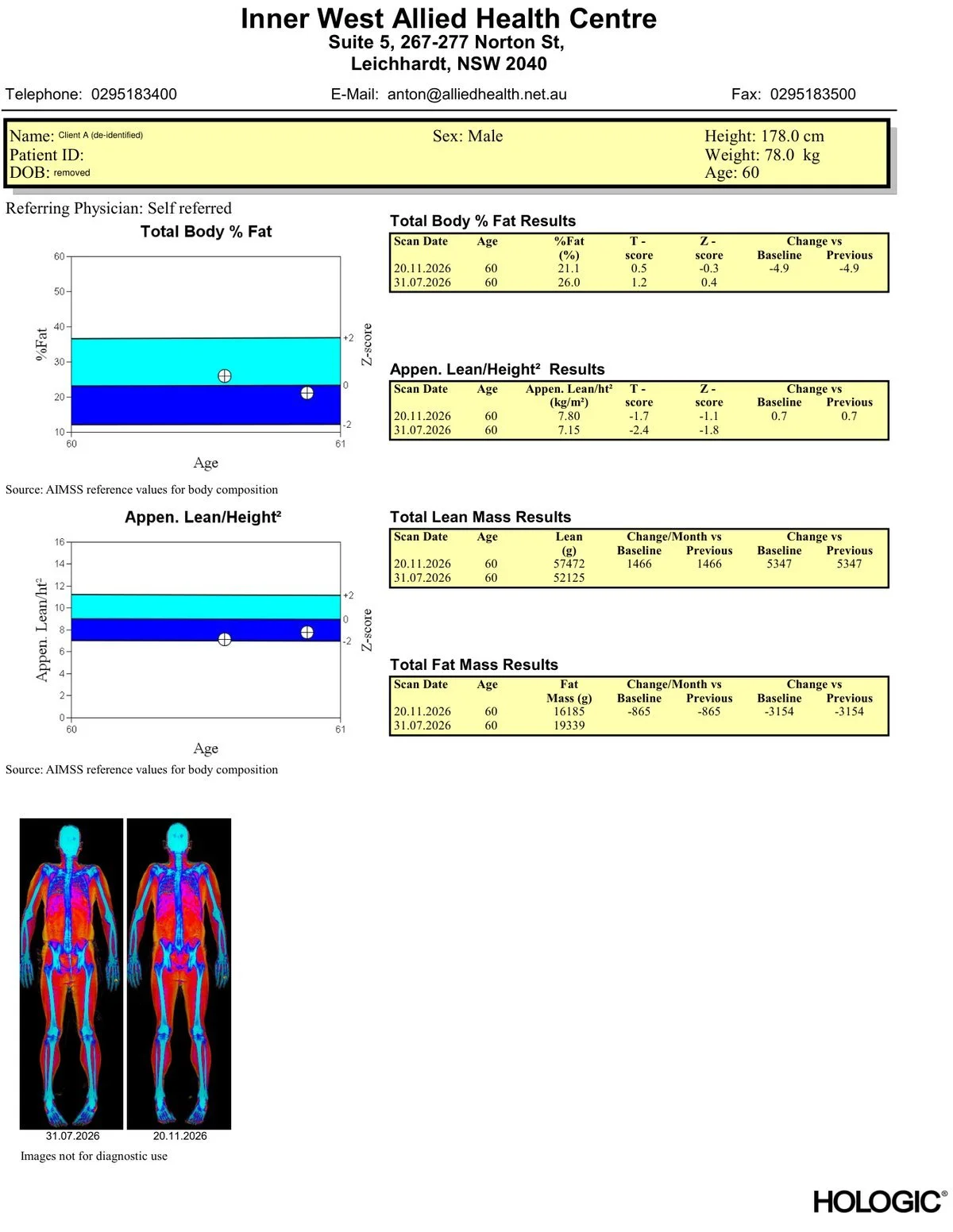
De-identified Hologic trend page: body fat %, ALMI, total lean mass and total fat mass across both scans.
Why the bathroom scale would have missed almost all of this
Over 16 weeks this client lost 3.2 kg of fat and gained 5.3 kg of lean tissue. Net result on the scale: 2.2 kg heavier.
Plenty of people over 60 start training, see the scale creep up, and quit because they think it is not working. Others diet hard, watch the scale drop and feel pleased, when a large share of that loss is muscle they can least afford to lose. Body weight alone cannot tell these situations apart. DEXA can.
How he trained: stress the muscle, not the joints
His program was built around one principle: load the muscles hard while keeping the joints comfortable. Exercises, ranges of movement and loads were chosen so the working muscles reached genuine fatigue without aggravating knees, hips, shoulders or the lower back. And he trained regularly, week in and week out, for the full 16 weeks.
That distinction matters more after 60 than at any other age. Joints are usually the limiting factor. Sore knees or a cranky shoulder stop many people long before their muscles have been challenged enough to grow. A program that stresses the muscle rather than the joint lets you train consistently, and consistency is what produces results like these.
Why purposeful, guided training gets better results
Purposeful training makes a significant difference to outcomes. Many people training on their own either do too little to stimulate muscle growth, or push through joint pain until they have to stop altogether. Neither builds muscle.
Harnessing the expertise of a physiotherapist closes that gap. Your program is built around your injury history, joint health and goals. Exercises are modified the moment something aggravates, rather than abandoned. Load is progressed at the right rate for your body, and progress is measured rather than guessed. In our experience, that guidance makes a bigger impact on training outcomes than going it alone.
What makes muscle gain possible after 60
The principles are the same at 60 as at 30, applied with more care:
Progressive resistance training. Two to three sessions a week, working each major muscle group, with the load gradually increased over time. Light weights and long walks are good for health but are not enough on their own to build muscle.
Enough protein, spread across the day. Older muscle is less responsive to protein, so needs are higher than many people expect, and many older adults eat too little of it at breakfast and lunch.
Recovery and sleep. Muscle is built between sessions, not during them.
A plan built around your injuries and joints. Arthritic knees, a stiff back or a past shoulder injury are reasons to adapt the program, not to avoid strength work.
Measuring, not guessing. Retesting every 12 to 16 weeks shows whether the plan is working and where to adjust it.
Frequently asked questions
Can you really build muscle after 60?
Yes. Research consistently shows people in their 60s, 70s and beyond gain muscle and strength with progressive resistance training. The client in this article gained 2.1 kg of arm and leg lean mass in 16 weeks at age 60.
Can you lose fat and gain muscle at the same time after 60?
Yes. This is called body recomposition. It is most achievable for people who are new to structured strength training or returning to it, and it is exactly what happened here: fat down 3.2 kg and lean mass up over the same 16 weeks.
How quickly can you gain muscle after 60?
It varies widely with starting point, training, nutrition and health. Measurable changes on DEXA are commonly seen within 12 to 16 weeks of consistent training, which is why we suggest retesting on that timeframe.
How do I know if I am gaining muscle or just gaining weight?
Only a body composition measurement can tell you. A whole-body DEXA scan separates fat, lean tissue and bone for each region of the body, with a very low radiation dose, and shows the change between scans to the gram.
Can strength training improve bone density after 60?
Strength and impact training are among the most effective ways to maintain and improve bone density with age. In this case total body bone density rose significantly over 16 weeks. Bone usually changes more slowly than muscle, so we track it over longer periods as well.
Should I train with a physiotherapist after 60?
If you have joint pain, past injuries, osteoporosis or a health condition, or you simply want the best return on your effort, yes. A physiotherapist can design a program that loads your muscles without overloading your joints, adjust it as you go and track your progress, which helps you train consistently and safely.
Measure your own starting point
Whether you want to build muscle, lose fat, protect your bones, or all three, the first step is knowing where you stand. At Inner West Allied Health & Specialist Centre in Leichhardt we have performed DEXA scans for more than 2,100 people. Every scan comes with a detailed interpretation report like the one shown above, comparing you with age-matched norms and with your own previous results. If you want a training program built around those results, our physiotherapists can design and supervise it.
Book your DEXA scan online, or book a baseline and review scan to measure your progress over time.
Read more about our DEXA body composition scans and bone density testing.
Written by Anton Sostaric, B.Physio, MAPA, physiotherapist with 33 years' experience and a special interest in metabolic and exercise testing, body composition and endurance performance.
Results shown are for one individual and are not a guarantee of outcome. Discuss any new exercise program with your doctor or physiotherapist, particularly if you have a heart condition, osteoporosis or a recent injury.